


















Introduction to Decentralized Technologies
Get 1000000 0FP0EXP Token to remove widget entirely!
Get 500000 0FP0EXP Token to remove my NFTS advertisements!
The Evolution of Trust and Compute
For the past three decades, the internet has primarily operated on a client-server paradigm. You (the client) ask a centralized server for information, and the server decides whether to grant it, alter it, or deny it. Trust is delegated to a single entity, which fundamentally creates a single point of failure and control.
Decentralized technologies flip this model entirely. Instead of a single centralized server, a global, permissionless network of computers (nodes) works together to maintain a shared, objective reality,. To achieve this without a central coordinator, the ecosystem relies on a deeply interconnected “stack” of technologies.
Understanding this stack requires breaking it down from the foundational mathematics at the very bottom, all the way up to the user-facing applications and economic incentives at the top.
The Decentralized Technology Stack
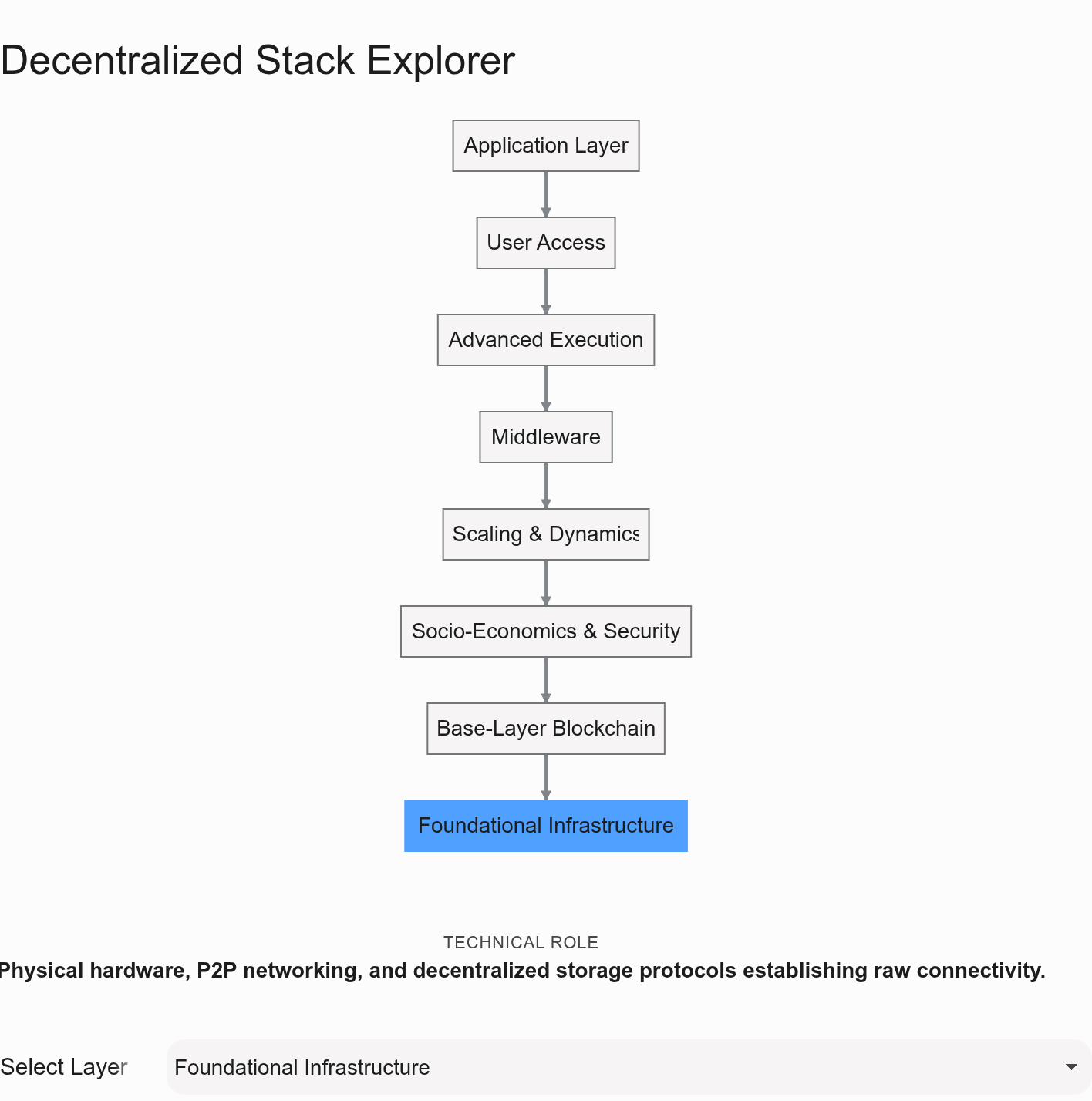
The 18 core topics we identified do not exist in a vacuum; they form a logical, bottom-up architecture. Lower layers provide objective truth and security, middle layers provide scale and connectivity, and upper layers provide utility and governance.
Below is the architectural map of this ecosystem.
flowchart TD
    subgraph Part VIII: Socio-Economics & Security
        Governance[Tokenomics & Governance]
        Security[Security & Forensics]
    end

    subgraph Part VII: Application Layer
        DApps[The dApp Stack & Frontend]
        DePIN[DePIN & DeAI]
    end

    subgraph Part VI: Advanced Execution
        Intent[Intent-Based Architectures]
        Privacy[Privacy & Zero-Knowledge]
    end

    subgraph Part V: Middleware & Interoperability
        Oracles[Oracles & Indexers]
        Bridging[Bridges & Interoperability]
    end

    subgraph Part IV: Scaling & In-Protocol Dynamics
        Rollups[Layer 2 Scaling & Rollups]
        MEV[MEV & Ordering]
        Storage[Decentralized Storage & DA]
        ZKVM[Verifiable Compute]
    end

    subgraph Part III: User Access
        Identity[Identity & Keys]
    end

    subgraph Part II: Base-Layer Blockchain
        VM[Execution Environments & VMs]
        State[State Management & Data]
        Consensus[Distributed Consensus]
    end

    subgraph Part I: Foundational Infrastructure
        P2P[P2P Networking]
        Crypto[Cryptographic Primitives]
    end

    %% Dependencies flowing upward
    Crypto --> P2P
    P2P --> Consensus
    Consensus --> State
    State --> VM
    VM --> Identity
    Identity --> Rollups
    Identity --> MEV
    VM --> Oracles
    Oracles --> Bridging
    Rollups --> DApps
    Bridging --> DApps
    DApps --> Governance
    Governance --> Security
Deconstructing the Journey: From Math to Applications
If we treat this syllabus as a journey, we are following the life cycle of a single piece of data as it transforms from a mathematical formula into a global application.
1. The Roots (Parts I & II)
Everything begins with Foundational Infrastructure. We use Cryptographic Primitives (like elliptic curves and hash functions) to create unforgeable digital signatures and verifiable data structures. Because there is no central server, these cryptographic messages must be broadcast across Peer-to-Peer (P2P) Networks using routing and gossip protocols.
Once the network is communicating, it must agree on a shared reality. This introduces the Base-Layer Blockchain. Nodes use Distributed Consensus (like Proof of Stake) to agree on the exact sequence of events. These events are written into a database (State Management) and executed by a Virtual Machine (like the EVM), turning the network from a simple ledger into a globally programmable computer.
2. The Bridge (Parts III & IV)
With the global computer running, we need a secure way to interact with it. User Access involves translating human intent into cryptographic signatures via Wallets, Seed Phrases, and Decentralized Identity primitives.
However, a single global computer gets congested quickly. Scaling & Dynamics addresses this bottleneck. We move heavy computation off the main chain using Layer 2 Rollups and Verifiable Off-Chain Compute (ZK Coprocessors), anchoring only the final cryptographic proof to the base layer. We also tackle the complex game theory of how transactions are ordered in the mempool (MEV) and where massive data files are permanently hosted (Decentralized Storage).
3. The Connectors (Parts V & VI)
Blockchains are fundamentally blind to the outside world—they only know what is written in their own state. Middleware & Interoperability solves this isolation. Oracles securely feed external real-world data (like asset prices or weather) into the network, while Bridges allow completely isolated blockchains to pass messages and tokens to one another.
Simultaneously, Advanced Execution paradigms are emerging. Zero-Knowledge Technologies allow users to prove statements (e.g., “I have enough funds”) without revealing the underlying sensitive data. Intent-Based Architectures shift the user experience from imperatively declaring how a transaction should execute to declaratively stating what outcome they want, letting decentralized solvers figure out the optimal routing.
4. The Frontier (Parts VII & VIII)
Finally, we reach the surface. The Application Layer is where developers build dApps, connecting standard web frontends to smart contracts. This layer is expanding rapidly beyond pure finance into DePIN (Decentralized Physical Infrastructure Networks, like distributed GPU rendering) and DeAI (decentralized artificial intelligence).
To sustain these ecosystems, we rely on Socio-Economics & Security. Tokenomics and Governance (DAOs) provide the incentive structures that keep participants honest and fund continuous open-source development. Because this code controls real value, Security & Forensics acts as the final shield, constantly hunting for smart contract vulnerabilities, auditing execution logic, and tracing malicious actors.